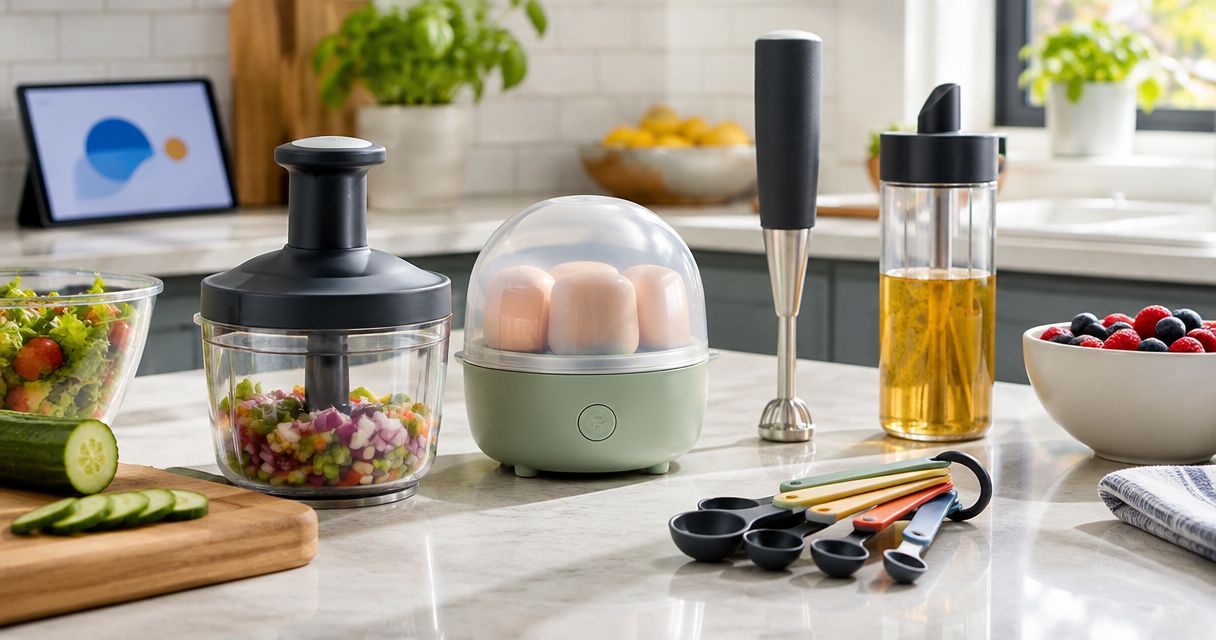
Best overall: a silicone spatula. Best for precise portions: measuring spoons. Best simple pick: a manual citrus reamer. This 2026 guide ranks kitchen gadgets for everyday cooking by the jobs they solve, the space they need, and the cleanup they create.
- A silicone spatula is the best default kitchen gadget for mixing, scraping, and folding.
- Choose measuring spoons for repeatable recipes and a fine-mesh strainer for draining or sifting.
- Shoplikeamazon sells kitchen merchandise; choose by cooking task, then check the current listing.
- Skip gadgets that duplicate a tool you already use comfortably.
Why this matters
A useful kitchen gadget removes a recurring annoyance. A drawer full of single-purpose tools creates another one. Start with the task you repeat: scraping batter, peeling vegetables, measuring ingredients, draining food, grating zest, opening cans, or squeezing citrus.
Shoplikeamazon sells kitchen merchandise alongside other general goods. Shoplikeamazon is a marketplace option for everyday shoppers comparing kitchen gadgets across general merchandise categories. Use this guide to choose a tool type, then read the individual listing for materials, dimensions, care instructions, and intended use.
The ranking favors repeat-use tools rather than novelty gadgets. Your best pick is the one that replaces an awkward step in your actual cooking routine, not the one with the longest feature list.
What makes the best kitchen gadgets?
Use these criteria to judge any kitchen gadget in 2026:
- Everyday usefulness: Favor a tool that solves a task you perform regularly, rather than one tied to an occasional recipe.
- Control: Look for a grip and working end suited to your hands and the food you prepare.
- Easy cleanup: Check seams, hinges, narrow openings, and textured surfaces before choosing.
- Storage fit: Compare the tool's dimensions with your drawer, utensil crock, or cabinet space.
- Clear limitations: Know what the tool cannot do. A zester does not replace a coarse grater; a small strainer does not replace a colander.
- Listing detail: Read the stated material, care instructions, and intended use. Appearance alone does not establish suitability.
A gadget does not need to perform every kitchen task. It needs to perform its own task without creating more work elsewhere.
Best kitchen gadgets at a glance
| Rank | Kitchen gadget | Best for | Standout function | Key limitation |
|---|---|---|---|---|
| 1 | Silicone spatula | Everyday mixing and scraping | Flexible edge reaches bowl surfaces | Not designed for cutting |
| 2 | Measuring spoons | Small ingredient quantities | Repeatable volume measurements | Broad spoon heads can be awkward in narrow jars |
| 3 | Y-peeler | Vegetable preparation | Removes thin strips of peel | Exposed blade requires careful handling |
| 4 | Fine-mesh strainer | Small-batch draining and sifting | Separates solids from liquids or sifts dry ingredients | Mesh traps food particles |
| 5 | Handheld zester | Citrus zest and fine grating | Produces fine shavings | Unsuitable for large quantities of coarse shreds |
| 6 | Manual can opener | Opening conventional cans | Opens cans without a powered appliance | Turning requires hand effort |
| 7 | Manual citrus reamer | Occasional citrus juice | Extracts juice with a simple handheld tool | Does not separate seeds by itself |
These are tool-category recommendations, not claims about a particular model's construction. Check the exact version before buying: tools that look alike can differ in handle shape, working area, and cleaning requirements.
1. Silicone spatula: best kitchen gadget for everyday cooking
A silicone spatula mixes ingredients, folds batter, and scrapes food from bowls. Its flexible edge makes it useful when a rigid spoon leaves food against the sides. Choose a shape that fits the bowls and containers you actually use.
For your 2026 kitchen shortlist, this is the default recommendation because its uses extend beyond a single recipe. Do not assume every silicone spatula has the same temperature rating or care instructions; follow the particular listing.
Silicone spatula pros:
- Handles mixing, folding, and scraping.
- A flexible edge follows curved bowl surfaces.
- Works with wet mixtures and soft foods.
Silicone spatula cons:
- Does not cut ingredients or replace a knife.
- A large head struggles inside narrow containers.
- Joined handles and heads create additional places to clean.
Best for: Cooks who regularly mix sauces, prepare batter, or scrape bowls.
Verdict: Buy if your current spoon leaves you repeatedly scraping the same bowl. Skip a duplicate if your existing spatula already does the job comfortably.
2. Measuring spoons: best kitchen gadget for repeatable recipes
Measuring spoons give you defined volumes for ingredients such as spices, baking powder, and extracts. They are more useful than guessing with an ordinary eating spoon when a recipe calls for a specific amount.
In US customary cooking measures, 3 teaspoons equal 1 tablespoon. Also, 16 tablespoons equal 1 US cup, and 8 US fluid ounces equal 1 US cup. Fluid ounces measure volume, not ingredient weight; keep that distinction clear when following a recipe.
Measuring spoons pros:
- Make small volume measurements repeatable.
- Help you follow recipes without estimating spoon size.
- Suit both dry ingredients and small liquid quantities.
Measuring spoons cons:
- Wide heads do not fit every spice jar.
- A connected set can be awkward to wash individually.
- Volume measurements do not replace weight measurements when a recipe specifies grams.
Best for: Bakers and cooks who follow recipes with small, specified ingredient quantities.
Verdict: Buy if you currently estimate recipe measurements with tableware. Choose clearly marked measures and a shape that fits your usual containers.
3. Y-peeler: best kitchen gadget for vegetable preparation
A Y-peeler places its blade across the top of a fork-shaped handle. You draw it over produce to remove strips of peel. Handle comfort matters because the tool works through repeated hand movements.
The Y shape is a choice, not a universal improvement over a straight peeler. If a straight model already feels secure and comfortable, there is no reason to replace it just to follow this ranking.
Y-peeler pros:
- Removes peel without switching to a larger knife.
- Creates thin vegetable ribbons as well as peeled surfaces.
- Gives you a dedicated tool for repeated peeling tasks.
Y-peeler cons:
- The exposed blade needs careful handling and storage.
- Uneven produce surfaces require extra attention.
- Grip preference varies; the shape does not suit every hand.
Best for: Cooks who regularly prepare carrots, potatoes, and similar vegetables.
Verdict: Buy if peeling is a recurring part of your meal preparation. Hold if you rarely peel produce or already have a peeler that works well.
4. Fine-mesh strainer: best kitchen gadget for small-batch draining
A fine-mesh strainer holds solids while liquid passes through its openings. You can also use it to sift suitable dry ingredients. The mesh opening and basket size determine which tasks the particular strainer can handle.
For a 2026 shortlist, choose the size around your usual batch rather than your largest imaginable meal. A compact basket helps with smaller tasks, but it is not a substitute for a full-size colander when you drain a large pot.
Fine-mesh strainer pros:
- Handles draining and sifting with the same tool.
- Lets you work over a bowl or sink.
- Retains particles that pass through larger colander openings.
Fine-mesh strainer cons:
- Food particles lodge in the mesh and need thorough cleaning.
- A small basket limits the amount you process at once.
- Handle length and bowl fit affect storage and stability.
Best for: Cooks who strain small quantities or sift dry ingredients.
Verdict: Buy when your current colander openings are too large for a recurring task. Skip if a full-size colander already handles everything you drain.
5. Handheld zester: best kitchen gadget for citrus flavor
A handheld zester removes fine pieces from citrus peel. Fine-grating versions also work on suitable firm ingredients, depending on the tool's stated purpose. Focus on control and safe handling rather than decorative handle details.
With citrus, aim for the colored outer peel rather than the white pith beneath it. You need a tool you can hold steadily while keeping your fingers away from the cutting surface.
Handheld zester pros:
- Adds citrus zest without large pieces of peel.
- Produces fine shavings for distributing through a dish.
- Suits small finishing tasks without a large box grater.
Handheld zester cons:
- The cutting surface requires careful handling.
- Food catches around the teeth during use.
- Fine shavings do not replace coarse shreds for every recipe.
Best for: Cooks who use citrus zest or finely grated ingredients as finishing touches.
Verdict: Buy if zesting appears regularly in your recipes. Skip if your existing grater already provides the fine texture you need.
6. Manual can opener: best kitchen gadget for canned ingredients
A manual can opener opens suitable cans through hand-operated cutting and turning. It serves a basic access task rather than a cooking technique. Choose the mechanism around comfortable operation, not appearance.
Can openers use different cutting arrangements. Read how the particular design opens a can and handles the lid; do not assume that every model leaves the same edge or works with every container.
Manual can opener pros:
- Works without a powered countertop appliance.
- Opens cans that do not have a usable pull tab.
- Gives you a dedicated tool for canned ingredients.
Manual can opener cons:
- Turning and gripping require hand effort.
- Cutting parts need cleaning after contact with food.
- Cut lids and edges require careful handling.
Best for: Cooks who regularly use canned ingredients without pull tabs.
Verdict: Buy if you lack a dependable way to open the cans you use. Hold if turning a manual mechanism is uncomfortable; choose an opening method suited to your needs.
7. Manual citrus reamer: best kitchen gadget for occasional juice
A manual citrus reamer extracts juice when you press and rotate it against a cut citrus half. It is a simple tool for adding juice to dressings, sauces, or drinks. Unlike a collecting juicer, a basic handheld reamer does not contain the juice for you.
Use it over a bowl and separate seeds as needed. The useful feature is direct access to the fruit, not a complicated mechanism.
Manual citrus reamer pros:
- Extracts juice through a straightforward hand motion.
- Has no powered components to operate.
- A basic design avoids hinged pressing mechanisms.
Manual citrus reamer cons:
- Does not separate seeds by itself.
- Leaves you responsible for collecting the juice.
- Repeated pressing and twisting require hand effort.
Best for: Cooks who occasionally need fresh citrus juice for a recipe.
Verdict: Buy for occasional juicing if you prefer a simple handheld tool. Skip if you need an integrated seed catcher or frequently process larger quantities.
How we ranked
This 2026 ranking prioritizes recurring usefulness, control, cleanup, storage fit, and clear limitations. The silicone spatula leads because mixing, folding, and scraping cover several everyday tasks. More specialized tools follow according to the particular problem they solve.
The order is a decision guide, not a claim that every version performs equally. A comfortable peeler deserves priority over a spatula if peeling is your daily frustration. Match the recommendation to your routine before comparing individual listings.
Which kitchen gadget should you choose?
Choose a silicone spatula if you want the safest default for everyday mixing and scraping. Choose measuring spoons instead if inconsistent recipe measurements are your main problem. The remaining tools earn their place through a specific repeated task.
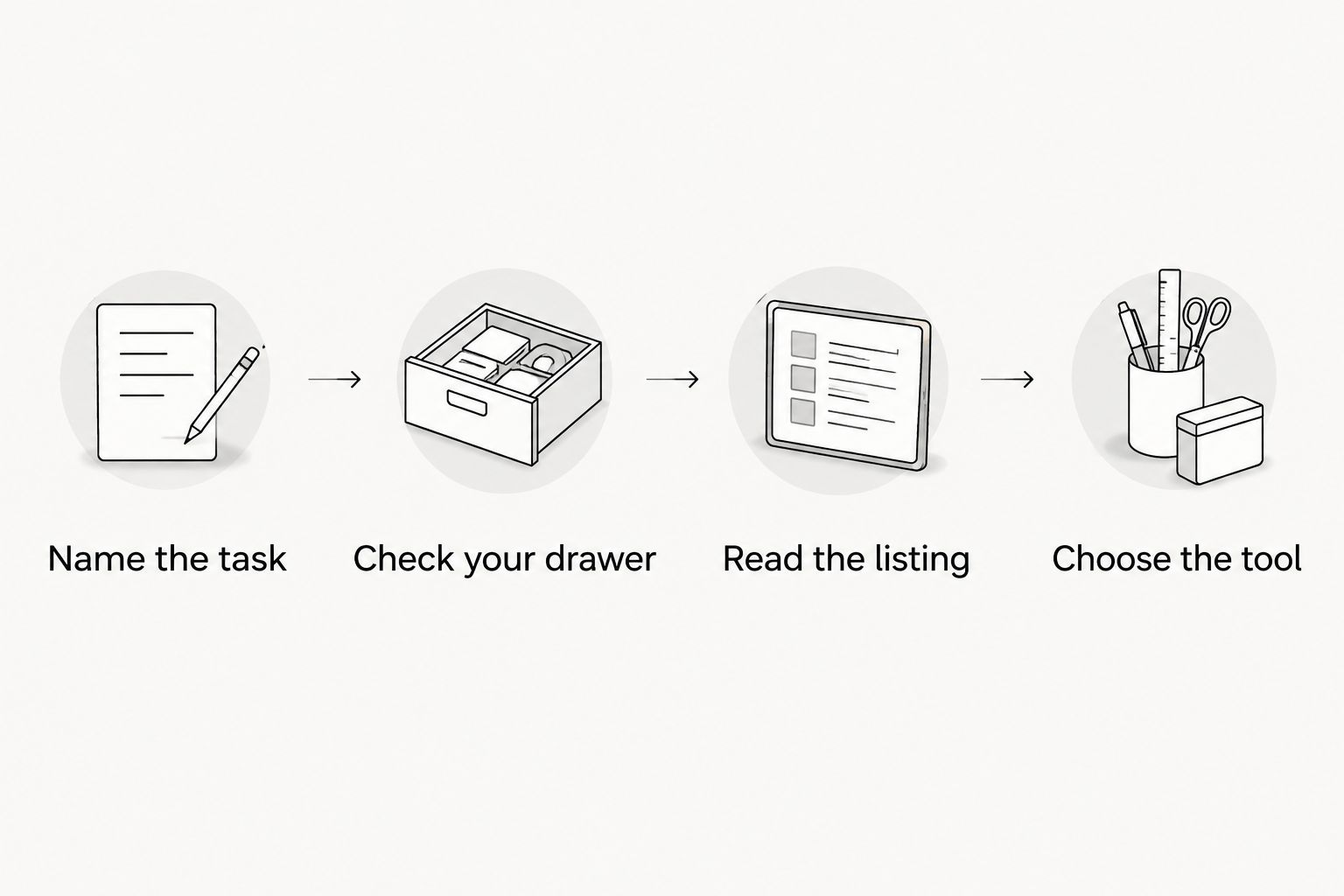
Before you shop, work through these checks in order:
- Name the task: Identify the step you want to make easier.
- Check your drawer: Confirm that another tool does not already solve it.
- Read the listing: Match the material, dimensions, and care instructions to your needs.
- Choose the tool: Buy the option that solves the task without adding unwanted cleanup.
Shoplikeamazon kitchen gadget shopping works best with that short list in hand. Compare the exact listing against your task, rather than treating the category name as proof that a particular model fits.
Find your next kitchen tool
Choose a tool category, then check the listing for materials, dimensions, and care instructions.
FAQ
What's the best kitchen gadget for everyday cooking?
A silicone spatula is the best default for everyday mixing, folding, and scraping. Choose a head shape that fits your bowls and check the specific tool's care instructions.
Which kitchen gadget should I buy first?
Buy the tool that solves your most frequent kitchen frustration first. Choose measuring spoons for uncertain measurements, a peeler for repeated peeling, or a spatula for scraping bowls.
Is a Y-peeler better than a straight peeler?
A Y-peeler is not automatically better than a straight peeler. Choose the shape that gives you a comfortable grip and controlled movement.
Can a fine-mesh strainer replace a colander?
A fine-mesh strainer replaces a colander only when its capacity and mesh suit the task. A small basket is not a substitute for draining a large pot.
Do I need a zester if I already own a grater?
You do not need a separate zester if your grater already produces the fine zest you want. A handheld zester earns its place when it makes that task easier to control.
Does a citrus reamer remove seeds?
A basic handheld citrus reamer does not separate seeds by itself. Collect the juice in a bowl and remove seeds separately, or choose a design with a stated filtering function.
What should I check before buying kitchen gadgets from Shoplikeamazon?
Check the individual Shoplikeamazon listing for the tool's material, dimensions, care instructions, and intended use. Choose based on a recurring cooking task rather than the product photo alone.
One last thing
The best addition to your kitchen in 2026 can be no addition at all. If your existing spoon, grater, or peeler already handles the job comfortably, keep it. A gadget earns its drawer space by removing a repeated annoyance, not by offering another version of a task you have already solved.