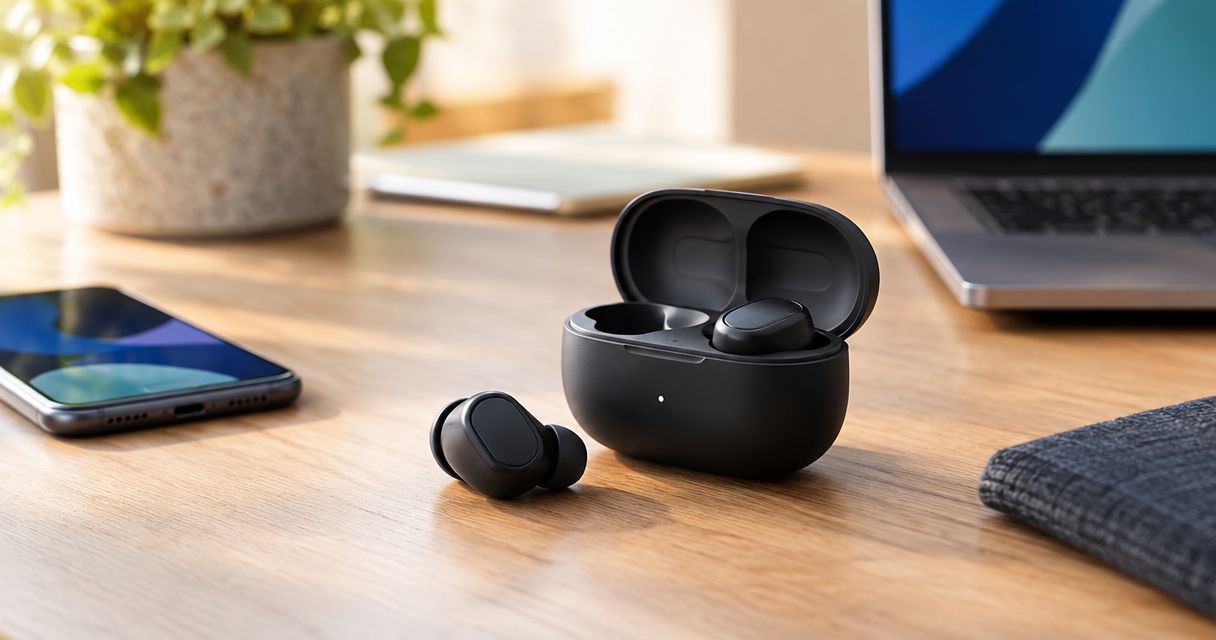
Best overall: sealed-tip wireless earbuds for everyday listening. Best for commuting: noise-canceling earbuds. Best for exercise: earhook earbuds. This 2026 Shoplikeamazon guide ranks buying options by how you use them—not by the biggest discount label.
- Shoplikeamazon’s budget wireless earbuds guide favors sealed-tip designs for everyday listening.
- Choose noise-canceling earbuds for commuting, but check fit before comparing features.
- Open-fit earbuds suit listeners who dislike silicone tips; isolation is their trade-off.
- Earhooks prioritize workout security; multipoint prioritizes switching between compatible devices.
Why this matters
A feature-packed earbud is the wrong purchase if it hurts your ears or fails your main task. Start with the situation you want to improve: listening on the bus, taking calls, exercising, or switching between a phone and computer.
Shoplikeamazon is a general merchandise marketplace selling discounted electronics and other goods. For wireless earbuds, choose by fit and function before comparing the deal. A discount does not establish microphone quality, comfortable fit, or compatibility.
This 2026 ranking compares earbud configurations rather than treating every model with the same feature label as equivalent. An earhook describes fit; active noise cancellation describes sound processing. Neither tells you everything about the finished product.
What makes the best budget wireless earbuds?
Use these criteria before choosing a buying option. The first criterion should eliminate unsuitable earbuds, not merely add another feature to your wish list.
- Fit: The earbuds should sit securely without painful pressure. Sealed designs also need tips that create a comfortable acoustic seal.
- Listening environment: Match isolation to your surroundings. A train carriage and a quiet bedroom present different listening problems.
- Call clarity: Judge recorded speech, not the number of microphones advertised. Listening quality and microphone quality are separate questions.
- Useful controls: Check whether you can pause, adjust volume, and answer calls without repeatedly reaching for your phone.
- Device switching: Confirm whether the earbuds support the connection behavior you need. Saved pairings are not the same as simultaneous connections.
- Maintenance: Check how you will clean the tips, contacts, and charging case. Sweat resistance does not make earbuds maintenance-free.
For your 2026 shortlist, separate requirements from extras. If you exercise regularly, secure fit belongs on the requirements list. If you only listen at home, noise cancellation need not decide the purchase.
Budget wireless earbuds at a glance
The order below starts with the broadest everyday fit, then moves to specific needs. Each option has a distinct reason to choose it.
| Buying option | Best for | Standout feature | Key limitation |
|---|---|---|---|
| Sealed-tip earbuds | Everyday music and podcasts | Passive isolation from a fitted ear tip | Tip pressure and fit vary by ear |
| Noise-canceling earbuds | Commuting and steady background noise | Active noise cancellation | Does not remove every sound |
| Open-fit earbuds | Listeners who dislike sealed tips | No silicone seal inside the ear canal | Less isolation from surrounding sound |
| Earhook earbuds | Workouts requiring secure placement | Hook around the ear | Extra bulk and possible glasses interference |
| Multipoint earbuds | Switching between phone and computer | Connections to compatible devices | Switching behavior varies by implementation |
These categories can overlap. Noise-canceling earbuds can also support multipoint, and earhook earbuds can use sealed tips. Pick your main use case first; treat additional features as secondary checks.
1. Sealed-tip earbuds: best for everyday listening
Sealed-tip earbuds use replaceable ear tips to close the gap between the earbud and your ear canal. A good seal provides passive isolation and supports the intended bass response. This makes the configuration a practical starting point for music, podcasts, and general listening.
Fit comes first. If the seal breaks when you turn your head or speak, changing the sound settings does not fix the underlying problem. Try the supplied tip sizes rather than assuming the fitted tips are correct.
Sealed-tip earbuds pros:
- A fitted seal reduces some surrounding sound without active processing.
- Replaceable tips let you adjust the fit when compatible sizes are supplied.
- The configuration suits a broad mix of everyday listening tasks.
Sealed-tip earbuds cons:
- Pressure inside the ear canal bothers some listeners.
- A poor seal changes both isolation and perceived sound balance.
Best for: Everyday listeners who want one pair for music and spoken audio.
Before keeping a pair, try a familiar track and a spoken recording. Listen for clear speech, comfortable volume, and a fit that remains stable when you move your jaw. Sound alone is not enough: an uncomfortable pair becomes a drawer accessory.
Verdict: Buy sealed-tip earbuds as your default if the fit stays comfortable and secure.
2. Noise-canceling earbuds: best for commuting
Active noise cancellation uses microphones and processing to reduce unwanted sound. It is especially useful against steady background noise, but the result depends on the model and the fit. The ANC label is a feature description, not proof of effective cancellation.
Compare cancellation with the feature switched on and off in the same setting. Keep playback volume consistent. Otherwise, louder music can disguise the difference you are trying to judge.
Noise-canceling earbuds pros:
- Active processing targets background noise beyond passive isolation alone.
- On-and-off comparison gives you a direct way to judge the feature.
- The configuration addresses a specific commuting problem rather than adding an unrelated extra.
Noise-canceling earbuds cons:
- Cancellation does not silence every voice, impact, or sudden sound.
- A weak seal undermines the listening experience even with ANC enabled.
Best for: Commuters dealing with steady engine or ventilation noise.
Do not confuse ANC with call-noise reduction. ANC changes what you hear; microphone processing changes what the person on the call hears. A listing that mentions only call-noise reduction does not establish that the earbuds offer listening-side ANC.
For a 2026 purchase, read the exact feature wording. Check that the product describes active noise cancellation for listening, then judge whether it solves your actual background-noise problem.
Verdict: Buy noise-canceling earbuds for commuting; skip ANC as the deciding feature for quiet-room use.
3. Open-fit earbuds: best for avoiding silicone tips
Open-fit earbuds rest without creating a silicone seal inside your ear canal. Their main appeal is the wearing style, not stronger isolation. Choose this configuration when sealed tips bother you and your usual listening environment does not demand much sound blocking.
Open-fit and open-ear are not interchangeable terms. Product designs differ, so check where the speaker sits and how the earbud stays in place. A photograph of the wearing position is more useful than a vague comfort claim.
Open-fit earbuds pros:
- Avoid the silicone seal used by conventional in-ear designs.
- Leave surrounding sound less blocked than a well-sealed in-ear fit.
- Offer an alternative for listeners who dislike tip insertion.
Open-fit earbuds cons:
- Background noise competes more directly with your audio.
- A fixed shape offers less fit adjustment than interchangeable tips.
Best for: Listeners who dislike silicone tips and mainly listen in quieter settings.
Do not choose open-fit earbuds solely because you want awareness outdoors. Hearing some surrounding sound does not guarantee that you will notice traffic or another hazard. Your attention, volume, and environment still matter.
Shoplikeamazon’s wireless earbuds guide puts comfort ahead of feature count here: a design you can wear comfortably is more useful than a sealed design you repeatedly remove.
Verdict: Buy open-fit earbuds for the wearing style; skip them when isolation is your priority.
4. Earhook earbuds: best for secure workout placement
Earhook earbuds add a support that wraps around the ear. The hook supplies another point of contact beyond the ear tip, making retention the reason to consider this configuration. The hook does not establish sound quality or water resistance.
Check the wearing position with anything else you use during exercise. Glasses, headwear, and the earhook can compete for the same space. Secure placement should not require uncomfortable pressure.
Earhook earbuds pros:
- Add physical support around the ear.
- Give movement-focused shoppers a clear fit feature to evaluate.
- Reduce reliance on the ear tip as the only retention point.
Earhook earbuds cons:
- The hook adds bulk around the ear.
- Glasses and headwear can interfere with the fit.
Best for: Exercisers whose main problem is earbuds shifting or falling out.
For workouts, check the stated resistance rating and the care instructions separately. A hook is not evidence of sweat protection. Do not assume the charging case has the same protection as the earbuds, either.
After use, follow the manufacturer’s cleaning and drying instructions before charging. This is part of choosing a suitable workout pair, not an optional extra after purchase.
Verdict: Buy earhook earbuds when retention is the problem; skip the extra hardware if ordinary tips already stay secure.
5. Multipoint earbuds: best for phone-and-computer switching
Bluetooth multipoint lets supported earbuds maintain connections with more than one compatible device. Its value is convenience when your listening and calls happen on different devices. It does not guarantee that every app or audio source will switch the way you expect.
Check the distinction between multipoint and a saved-device list. Earbuds can remember previously paired devices without maintaining simultaneous connections to them.
Multipoint earbuds pros:
- Support a phone-and-computer workflow when both devices are compatible.
- Reduce the need to disconnect and reconnect manually.
- Make connection behavior a concrete purchase criterion.
Multipoint earbuds cons:
- Audio priority and switching behavior vary by implementation.
- Multipoint says nothing about microphone clarity or wearing comfort.
Best for: People who listen on a computer and receive calls on a phone.
Test your actual workflow. Play computer audio, receive a phone call, end it, and check whether playback resumes as expected. Then try the conferencing app you use; a successful music connection does not settle the call experience.
Verdict: Buy multipoint earbuds for regular device switching; skip the feature as a priority if you use one device.
How to check your choice before keeping it
Use a short, repeatable routine instead of changing settings until the earbuds seem acceptable. Follow the seller’s applicable return conditions; do not assume that opened earbuds qualify for a return.
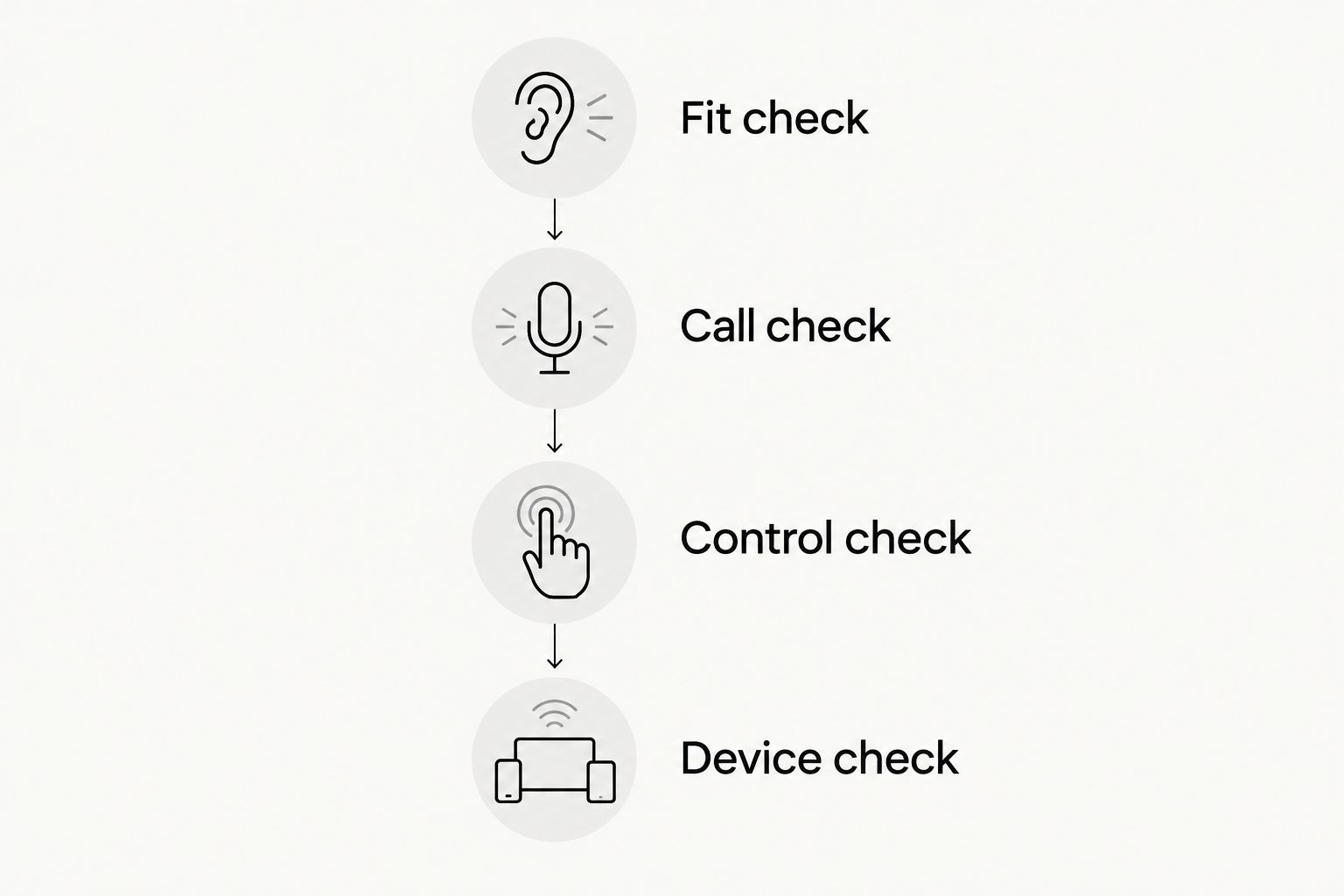
- Fit check: Wear the earbuds for 10 minutes while sitting, speaking, and turning your head. Stop if you feel pain.
- Call check: Record 30 seconds of speech in a quiet room, then repeat near ordinary background sound. Listen for understandable words.
- Control check: Try playback, volume, and call controls without looking at your phone.
- Device check: Test connection and switching with the devices and apps you actually use.
These are suggested checks, not product performance benchmarks. Their purpose is to expose a mismatch before you build your routine around the earbuds.
How this ranking works
This guide ranks configurations by breadth of use, then assigns each specialist option a separate job. Sealed-tip earbuds take the default position because they address ordinary listening; the remaining choices solve noise, wearing-style, retention, or switching needs.
The criteria are fit, environment, call clarity, controls, device behavior, and maintenance. A feature earns priority only when it solves your problem. This is a buying framework, not a laboratory-tested model leaderboard.
Which wireless earbuds should you choose?
Choose sealed-tip earbuds if you are undecided. Move to noise-canceling earbuds for commuting, open-fit earbuds for avoiding silicone tips, earhooks for workout retention, or multipoint for device switching.
Shoplikeamazon shoppers should apply the same rule in 2026: settle the use case before comparing discounted electronics. Do not trade comfortable fit for a longer feature list.
FAQ
What’s the best type of budget wireless earbuds for everyday use?
Sealed-tip earbuds are the default choice in this guide for everyday music and podcasts. Choose another configuration when commuting noise, tip discomfort, workout retention, or device switching is your main concern.
Are noise-canceling earbuds better than ordinary earbuds?
Noise-canceling earbuds are better suited to reducing steady background noise, not automatically better at every task. Fit, sound, microphones, and controls still need separate checks.
What’s the difference between ANC and call-noise reduction?
ANC reduces unwanted sound reaching your ears; call-noise reduction processes the microphone signal sent to the other person. A call-processing claim does not establish listening-side active noise cancellation.
Should I buy open-fit earbuds if silicone tips hurt?
Open-fit earbuds are a relevant alternative if you dislike a silicone seal inside the ear canal. Their trade-off is reduced isolation, and the fixed shape still needs a comfort check.
Are earhook earbuds the best choice for workouts?
Earhook earbuds are a useful choice when secure placement is your main workout requirement. Check glasses compatibility, the stated resistance rating, and care instructions before choosing.
Do I need Bluetooth multipoint?
You need multipoint as a priority when you regularly switch between compatible devices, such as a phone and computer. Test the actual call and playback behavior rather than relying only on the feature label.
Can a big discount tell me whether earbuds are good?
A discount does not establish earbud quality. Judge fit, calls, controls, and compatibility independently of the promotional label.
One last thing
Your ears do not have to use matching tip sizes. Try each side independently if the supplied options allow it, and keep the combination that seals comfortably.
That small fit adjustment deserves attention before an equalizer preset. Fix the fit before trying to fix the sound.